Sardinia is a land where nature is a constant presence. In its open landscapes, in the silence of the countryside, and in the intense colors that mark the changing seasons, one can sense an ancient balance between people and the world around them. Over time, the island’s rural communities have developed a relationship with nature based on observation, respect, and coexistence.
Nature thus becomes both origin and reference, capable of shaping gestures, rhythms, and forms of expression. This deep connection is also reflected in craftsmanship and decorative arts, where recurring motifs inspired by natural elements are not merely ornaments, but signs of a genuine familiarity with the environment. In this sense, nature is not simply represented: it becomes an integral part of a language that unites aesthetics and identity.
In traditional costumes, shades of purple, blue, red, and green intertwine in chromatic harmonies that convey identity and memory. Inspired by this visual heritage, RR Orafi in Sassari has created a new collection of Sardinian jewelry that reinterprets the floral motif through a contemporary language while preserving its connection to tradition.
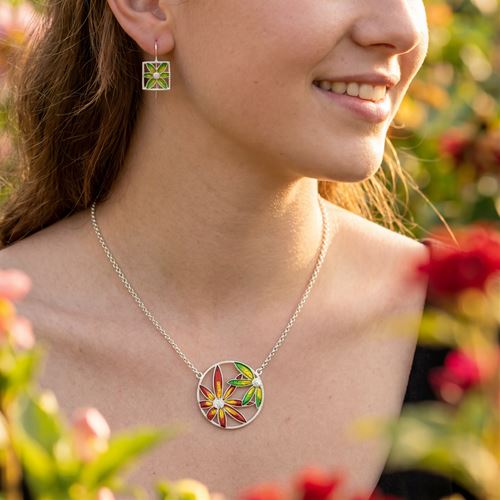
The heart of the collection is represented by floral compositions in traditional Sardinian filigree: fine silver threads, patiently shaped and interwoven, form the corollas and delicate frames of the jewelry pieces. The characteristic spiral, or corbula motif, visible at the center of each flower, anchors the enameled petals. With its vivid tones, the enamel recalls the colors of traditional costumes. Each flower is born from a balance between structure and lightness: the filigree creates the framework, while the enamel adds depth and character.
This craftsmanship not only gives the jewelry a sense of visual lightness, but the translucent enameling also creates a play of transparency that changes according to the angle and natural light, evoking the vibrant harmony of colors found in nature and celebrated during festivals and processions such as the Feast of Sant’Efisio in Cagliari and the Cavalcata Sarda in Sassari.